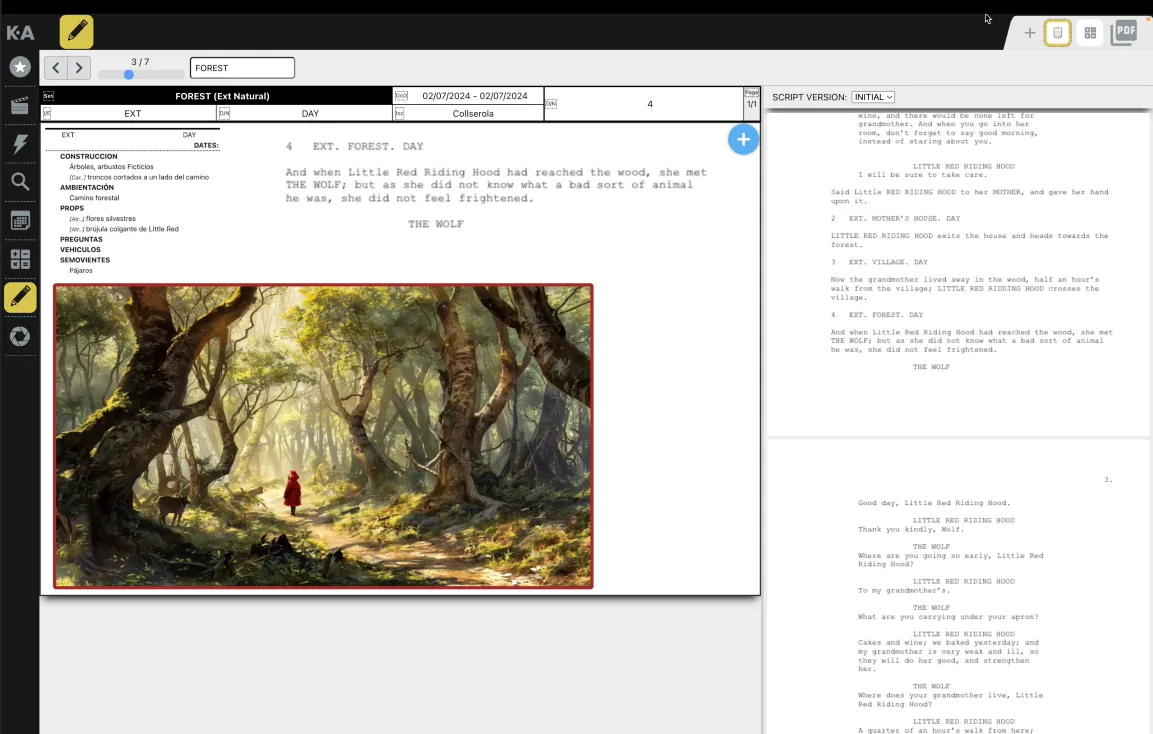
We are thrilled to announce that on September 1st, Keynema will officially launch—a tool designed to assist creative teams in managing their workflows and logistics.
After years of dedicating time, effort, personal investment, and a long journey through the wilderness, we have developed a tool that will be a game-changer for many of us in the audiovisual industry.
What is Keynema?
Thanks to a combination of artificial intelligence and robust document and template management software developed by industry technicians, Keynema becomes your ideal co-pilot for any department (currently artistic) of a film project.
Keynema has two interchangeable modes: K·Production Design, covering production design and art, props, locations, graphic artists, suppliers, animal or vehicle coordinators or stunts, among others; and K·Character Creator, designed for wardrobe, makeup, prosthetics, hairdressing…
Keynema loads and analyzes your script, and for the whole project, it facilitates the creation and editing of outlines, breakdowns, budgets, team calendars, shooting plans, and set continuity. It manages listings and searches of all kinds, creates detailed character sheets and changes, and organizes essential documents for scouts and technical locations.
We have worked to make Keynema the tool we all dreamed of to securely generate and store all the information necessary to carry out films, series, shorts, or documentaries efficiently and coordinated, allowing us much more time to be creative.
How did Keynema start?
Our journey began from a simple observation: artistic departments in the audiovisual industry often lose a lot of time managing outdated paperwork. The frustration grew when we saw that existing logistics software was largely designed for the early stages of writers, directors, or producers, rarely meeting the specific needs of the creative teams who design the films.
Driven by the desire to change this landscape, we developed Keynema to empower creatives not only to have logistical control but also to focus much more on what we do best: create.
Leveraging AI to unleash your creativity
To ensure that you can focus more on creation, we have developed an in-house AI model that reliably automates the tedious tasks of audiovisual work and, using top-tier security services, incorporates the best AI applications on the market to rapidly accelerate results, allowing you to receive extensive script information in just minutes. But this is only a part of all the capabilities that Keynema will integrate; you can upload photos, notes, export budgets, listings, calendars…
Join us on this journey
As September approaches, we invite you to join us in this new revolution in creative project management, designed to free you from logistical burdens and unleash your creative potential.
Also, participate in our beta testing phase by visiting keynema.com. This is your opportunity to experience the advantages of Keynema firsthand and be part of the project by providing your feedback, suggestions, and ideas.
For this, do not hesitate to request your beta version here: keynema.com
We are eager to see how Keynema transforms your projects and workflows. Stay tuned for more updates and get ready to experience the future of film production, where your creativity knows no bounds.
Tests and acknowledgments
Keynema has undergone rigorous beta testing in up to fourteen commercial projects, including art, props, and wardrobe teams from projects such as ‘Narcos: Mexico’ (various creators and directors), Neil Jordan’s ‘Marlowe’, or Icíar Bollaín’s ‘Maixabel’.
Last but not least
This project would not have been possible without the collaboration of professionals like Patricia Cuevas, Irantzu Ortiz, and Misbah Rashid, and without the help of team leaders like Steff Helmreich, Mario Suances, Mikel Serrano, Ane Arteaga, Kemen Arnoso, Mayte Sym, Perico Valero, Evelin Hernández, Marina Pozanco, Gigia Pellegrini, Esther Alonso, Joan Arti, Ana Pons-Formosa, or Berta Faig.
As well as without the support of Teresa Roig from the University Pompeu Fabra, Alexandra Rueda from the Creamedia program of Barcelona Activa, and all the people from their teams.
To all of you, a million thanks!
Artificial Intelligence in Audiovisual Production: Observatory Debate
Encounter and debate in Barcelona
The recent panel organized by the PAC (Productors Audiovisuals de Catalunya), held on October 15th in Barcelona, turned out to be an ideal opportunity to discuss the impact of Artificial Intelligences in the Audiovisual sector.
Under the title “La producció audiovisual davant la IA,” the event focused on exploring the impact of artificial intelligence in cinema and television, addressing whether technology represents a threat or a valuable tool for the future of the sector, its short-term implications, and whether regulation is necessary and how.
Here’s the link to the debate, unfortunately only available in Catalan:
The evolution and mission of the event organizer
Since its inception in 1978, the PAC has been the voice of audiovisual producers in Catalonia, evolving from its foundation to become an entity that not only defends the interests of its members but also promotes innovation and adaptation to technological changes. In this context, the PAC organized this debate to delve into how AI can be integrated ethically and effectively into audiovisual production processes.
Link to the PAC: https://pac.cat
Keynema and AI: a vision for the future
Mani Martinez, CEO and co-founder of Keynema, offered a perspective aimed at clarifying the role of AI in the industry. Contrary to the notion that AI could replace human creativity, M. Martinez argued that AI should be considered an extension of the tools that creatives use to realize their vision and that education is much more useful than regulation in that regard.
According to M. Martinez and Keynema, artificial intelligence is most effective when acting as an assistant that handles repetitive tasks, allowing creators to focus on the artistic aspect of their projects.
Democratization and rights in the digital era
One of the key points of the debate was how AI is democratizing audiovisual production, making technology accessible to a broader spectrum of creators. This can be seen in the example of the arrival of digital in cinema, which was heavily criticized in its early years but has enriched the industry with various formats, sometimes more independent, while substantially improving digital effects in the medium.
However, sensitive topics such as copyright or image rights, such as those of performers in the digital age, were also touched upon. Despite the integration of new technologies, existing regulations and legal solutions still apply, ensuring that the rights of creators and actors remain protected under legislation that has proven effective over time. But mostly that indicates that what we call AI is nothing more than a set of tools that perhaps we must learn that can not be regulated in themselves, but will make the current regulatory system more complex. Behind the IAs, even though they want to sell us that they work alone, there is always the human commissioner.
Prominent voices in the debate
The debate was not only a platform to discuss the role and future of AI in audiovisual production but also an opportunity to learn from prominent figures who enriched the discussion with their experiences and perspective:
– Anna Giralt: Filmmaker and researcher, co-founder of Artefacto and Gusano Films, and director of the RAIN FILM FESTIVAL, the first international festival of films created by AI. Her work focuses on exploring the intersections between technology and visual narrative.
– Daniel Muñoz Cañeiro: Director and screenwriter trained at CECC and ECAM, recognized in the industry for his documentary “El año del descubrimiento,” winner of a Goya. His approach combines deep social analysis with innovative techniques in cinematography.
– Bárbara López: Director of actors with extensive experience in various media such as radio, television, and special effects. Bárbara is known for her ability to direct emotional and technically complex performances.
– Mani Martinez: (co-founder of Keynema Suite) Trained in Fine Arts at Camberwell, Mani has a 25-year career in the audiovisual industry, working on both international and national projects. As an activist in the Sindicat TACE, he has contributed to significant labor reforms. Currently, he teaches courses at ESCAC, integrating generative AI into film design.
Conclusion: AI as an ally of art
The debate at the PAC has underscored that artificial intelligence, far from being a threat, offers unprecedented opportunities to expand creative expression within the audiovisual industry. The key is to use AI as a tool that complements and expands human capabilities, not replaces them.
In this new scenario, the PAC and Keynema, from different perspectives, emerge as entities that share a natural interest in how these technologies can better serve the creative community, ensuring that technological innovation goes hand in hand with artistic integrity and creators’ rights.